
America by car, part 9/10 - San Francisco
As we approached the city on the highway, we expected a similar glow to the one over Las Vegas. Yes - the glow was - it started with the lights of the Oakland airport (actually the "suburbs" of San Francisco). The weather surprised us - a few miles before SF there was a beautiful starry night, clear sky, the moon two nights before the full moon. Moments later, a gigantic fog (cloud?) Hung over the city, giving us a gentle drizzle. As we pulled off the Bay Bridge, we turned towards (as our girls say) "the very center" of SF, and the scenery was fairy-tale-comic.
Imagine: the night, dim light from behind the clouds, a specific fog suddenly falling on the city, skyscrapers in the downtown, which are not visible to the spiers, but you can feel their presence ... Great, a bit dark atmosphere - such Gotham City in light rain.
We found the hotel (The Union Square Plaza Hotel on Geary Street) in no time, it turned out to be a bit worse than our standard Travelodge motel, but it benefited from one thing: LOCATION. Located right next to the HIGH CENTER, San Franciso has proved to be a great base for exploring the city with the help of its public transport. After a little rest and support, we finally gathered and after midnight we set off into the city. A walk around the nearby Union Square (the text "strict center" begins to be the hallmark of our trip). It turned out that SF goes to sleep at this time (at least in the very center) and we finally sat down in the only working Irish pub in the area.
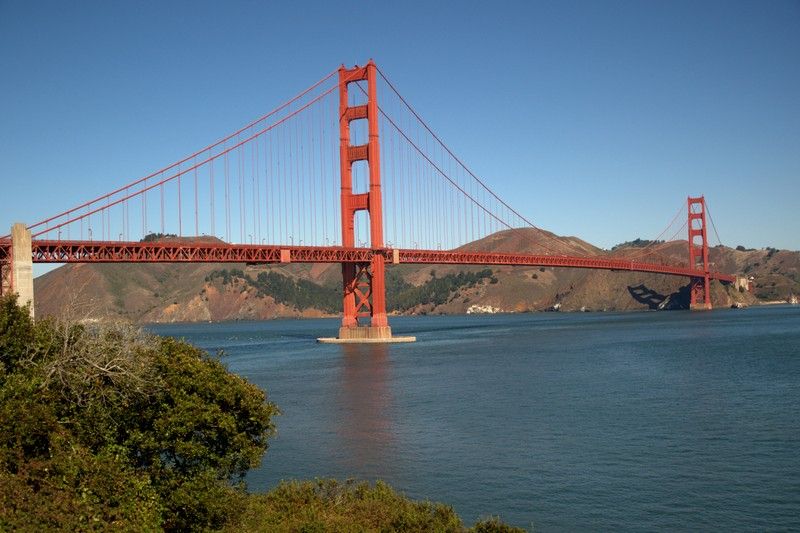
Yesterday, i.e. Wednesday, 6.05. we gathered decently and already around 11 o'clock we were having breakfast in "Lori, s" - a classic American pub, where you sit in red, leather boxes, there is a chessboard on the floor, and the waitress politely pours coffee from the jug ... After breakfast we went on a classic San Francisco tour. First, a ride on the famous "cable car" - Cable Car - along the bizarre streets of SF - up, down, up and down ... then walk around Chinatown (shopping to Marcin's camera) towards Coit Tower. From under the tower there was a beautiful view of the bay and… the Golden Gate, which was not there.
Well, while it was understandable that we do not see this legendary bridge (I have the impression that I use the word "legendary" every now and then - if so - forgive me) when entering the city, the next day, when we went to Coit Tower in fine weather - we expected to see this miracle of engineering, which (as we were told) was to be visible from this place in all its glory ... What was our surprise when, after climbing the last few dozen steps to the parking lot under the tower (funded years ago by a wealthy citizen of SF) - WE DIDN'T SEE THE BRIDGE ... A magnificent view of the bay, in the foreground the bustling pier of Pier 39 , and the place where the bridge should theoretically be - shrouded in fog ...
"We didn't agree like that," you'd like to say, but well - we had to be patient and wait ...
We took the bus from Coit Tower (earlier, before the tram ride, we bought day tickets for public transport for only $ 11 / person) to the aforementioned Pier 39, which can be described as something like a wooden pier built up with shops and restaurants. The biggest attraction here is undoubtedly the Sea Lions - Sea Lions (for me - just bigger seals), which lie - several hundred in number - on the coastal piers and gracefully pose for excited tourists. It wasn't the first time, therefore, that we felt like classic Japanese tourists, whom we used to make fun of (read slang: tearing the shoals / rags) ... Another time during this trip we shot our cameras - this time - at the sun lounging. " seal ".
In the afternoon, we ate a decent but square pizza in the neighborhood pompously known as Little Italy and headed to another tourist attraction - Lombards Street. The whole thing about this street is that on its very short section (about 200 meters in a straight line) it is quite twisted. Twisting means - no more or less - only a few very sharp bends and a very steep slope of the road at the same time. Lombards Street has one direction of going up and down. In the evening, a two-hour session (not necessarily ofkors) at the Marshall's outlet on one of the main arteries of the city - Market Street. The girls fell into a trance, but this was just a foretaste (on the radio we would say in English - tease) of what was about to happen.
Late in the evening, after a short rest at the hotel, we went for a walk around the area. Unfortunately, the area, despite - let me remind you - STRONG CENTER - abounds in crowds of the so-called they chewed the common ones - not to be confused with the tramps. It made a walk near Union Square exciting, adventure in the air, and… it smelled like power - from sneaking, wandering, sleeping homeless people.
I invite you to read the next part about the way back to Los Angeles

I crossed America by car and I am happy to tell you about it!